Golf simulator bars combine food, drinks, and interactive golf entertainment into one experience, and they’re showing up in bars, restaurants, and social clubs across the country. Even a single simulator bay can increase dwell time, open up new revenue, and give people a reason to stay for another round.
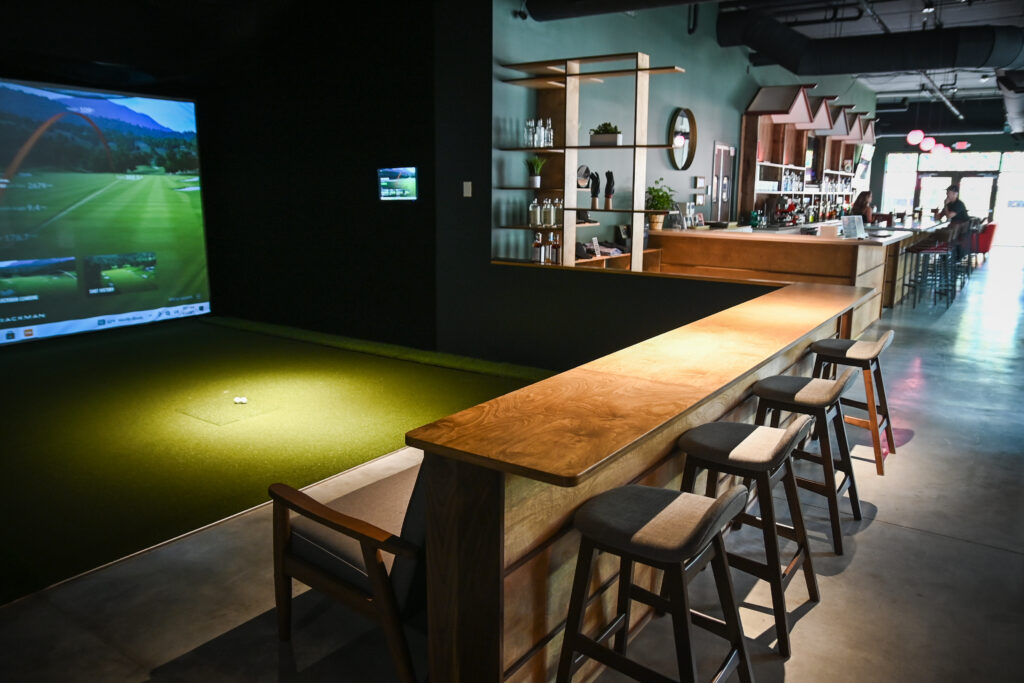
From axe throwing to vintage arcades and photo booths, bars and restaurants have learned that entertainment drives longer stays and higher tabs. Golf simulators follow the same model, but with an activity that appeals to both casual guests and serious golfers.
We’ve seen this work firsthand at venues like Blind Shot Social Club. Although it was designed as a hybrid indoor golf and restaurant concept, even one simulator has proven valuable for keeping guests engaged and coming back.
Golf simulator bars work especially well for venues that already host groups, events, or longer stays, but they don’t require a full indoor golf concept to be successful.
GOLF SIMULATOR BAR DESIGN IDEAS
Golf simulators don’t have to dominate your floor plan to be effective. Many successful golf simulator bars use compact or flexible designs that fit naturally into their existing space.
- A single simulator bay tucked behind the bar or in a private lounge area (Many bars start with a single bay to test demand before expanding or reworking the space)
- Multi-use bays that double as a large TV wall during sporting events
- Quick-play formats where guests pay by the hole, round, or time slot
- Closest-to-the-pin or longest-drive challenges that rotate weekly
- Layouts that accommodate both right- and left-handed golfers without adjustment
A modest commercial golf simulator setup can start around $15,000, with options to scale up or down depending on space and goals. How venues choose to monetize, by the hour, round, or as part of an event, varies by concept, but many find it adds a meaningful new revenue stream.
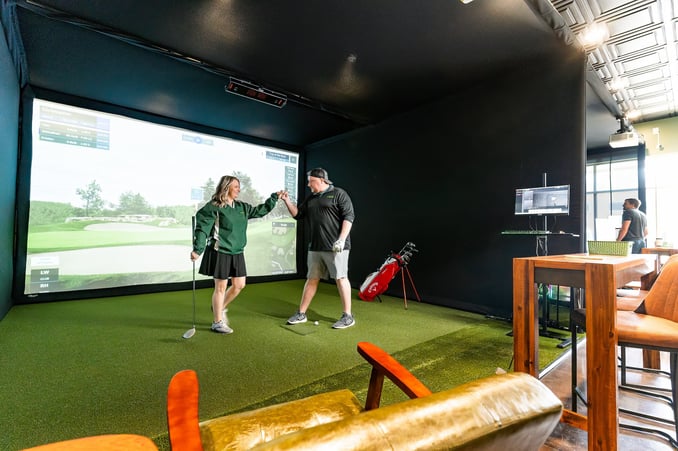
WHAT A GOLF SIMULATOR BAR ACTUALLY NEEDS
Ideally, a golf simulator in a restaurant or bar would include an enclosure, impact screen, launch monitor, software, projector and a computer to be the main hub of the technology.
GOLF SIMULATOR ENCLOSURE AND IMPACT SCREEN
The enclosure and impact screen define how a golf simulator looks, feels, and functions in a bar or restaurant setting. The enclosure contains shots and controls ambient light, while the impact screen displays the course and absorbs repeated ball strikes.
Most commercial venues choose one of three approaches, depending on space and aesthetic goals:
- Pro Enclosure - A polished, durable option built for high-traffic commercial use.
- Built-In Golf Room Kit - A sleek, custom-fit solution designed to integrate directly into the space for a clean, built-in look.
- DIY Enclosure - A more flexible option for tighter layouts or budget-conscious builds.
Regardless of enclosure style, a Premium Impact Screen is recommended for commercial environments. It’s quieter at impact, holds up better under constant use, and delivers the best projected image quality.
GOLF SIMULATOR LAUNCH MONITOR
A launch monitor is the brains of the operation; it’s the piece of technology that is able to read or track the club and/or ball as the golfer swings to show you how the ball would fly in real life.
Ideally, you’ll want a higher end launch monitor that provides an awesome experience for your customers, so we would suggest an overhead unit from Uneekor, Foresight, or Trackman.
For a commercial business, we recommend overhead launch monitors since they are mounted up and out of the way of the golfing area, so you don’t have to worry about them getting knocked over or damaged from people traffic walking around or through.
Also, centrally mounted overhead launch monitors allows both righties and lefties to seamlessly play at the same time as well.
If budget is of concern, you could go with a ground radar-based launch monitor which also gives the benefit of not having to be moved back and forth depending on if the golfer is left- or right-handed. But with ground units, they stand a higher risk of getting knocked over repeatedly. Not only will this likely damage your unit over time, but also force you to realign them often.
GOLF SIMULATOR SOFTWARE
Golf simulator software takes the data captured by the launch monitor and turns it into on-screen shots, games, and courses. Some launch monitors include software, while others require an additional license, so it’s worth checking what’s included before you commit. Make sure to check if the software is for commercial use: mult-use bays, leagues, reservations, and course rights. Software that is for home use may differ for commercial use.
The software runs on a dedicated computer that acts as the hub of the system, so compatibility and performance requirements are worth factoring into your setup.
If you plan on running leagues or events, look for software that supports multiplayer play, scoring, and repeatable formats that work well in a bar or restaurant setting.
GOLF SIMULATOR PROJECTOR
The right projector depends mostly on space and placement. In larger bar or restaurant layouts, the projector can be mounted farther back and kept safely out of the swing zone. In tighter spaces, short-throw projectors allow you to mount closer to the screen without sacrificing image size or clarity.
Focus on brightness, placement flexibility, and reliability in commercial settings, then choose the projector that best fits your space.
GOLF SIMULATOR HITTING AREA
Don’t forget the hitting mat and surrounding turf. Commercial setups benefit from turf that’s durable, low-maintenance, and comfortable for golfers who may be standing and swinging for long stretches.
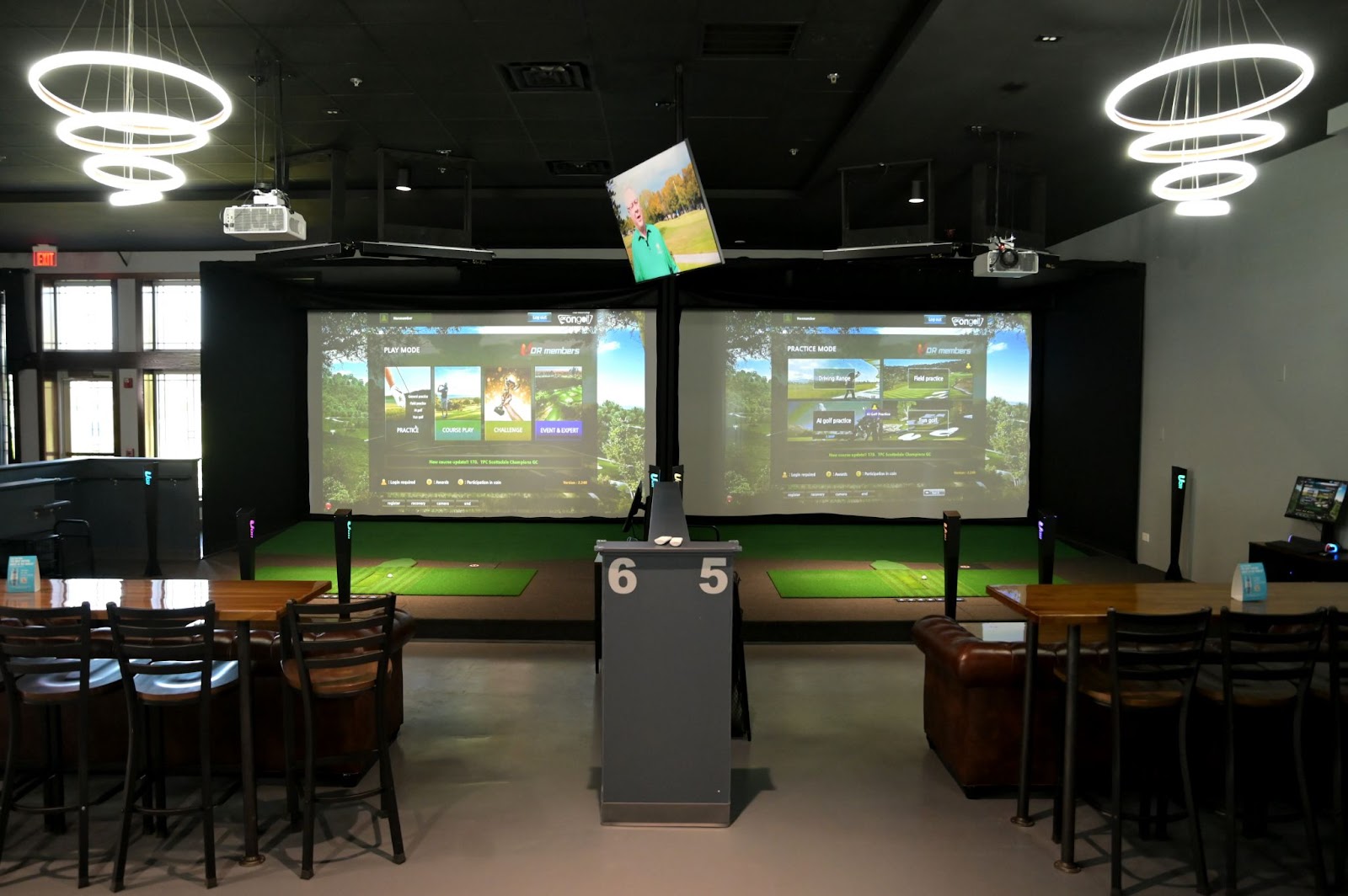
COMMON PLANNING MISTAKES TO AVOID
Most issues we see with commercial golf simulator installs aren’t about the equipment itself, they come from planning oversights early on. Avoiding a few common mistakes can make the difference between a simulator that feels seamless and one that feels like it was squeezed in.
- Underestimating ceiling height and swing clearance. Ceiling height, stance position, and swing arc all matter more in a commercial space where players vary widely. Planning this early helps avoid last-minute compromises.
- Placing the simulator in a high-traffic walkway. Simulators work best when they feel intentional. Positioning a bay where people constantly walk through increases safety concerns and disrupts gameplay.
- Choosing equipment designed only for home use. Bars and restaurants put far more wear on equipment. Commercial environments benefit from durable components built to handle frequent use.
- Skipping layout and spacing checks. Rushing into equipment selection before confirming room dimensions can limit placement options later. Starting with accurate measurements and layout planning helps everything fit the way it should.
If you’re early in the planning phase, this guide to golf simulator space requirements walks through the key measurements and considerations that tend to trip people up.
HOW BARS ACTUALLY USE GOLF SIMULATORS
Most venues run simulators self-guided, with minimal staff involvement beyond basic oversight and scheduling.
In a bar or restaurant setting, golf simulators are less about serious training and more about shared entertainment. They work just as well for first-time players as they do for experienced golfers.
- Casual play during regular service hours
- Parties, birthdays, and bachelor or bachelorette events
- Weekly challenges like closest-to-the-pin or longest drive
- Small leagues or recurring events, even with a single bay
- Dual-use viewing when the simulator isn’t in use, throw on a football game
The key is flexibility. Even one simulator can support multiple uses throughout the week, depending on how you want it to fit into your concept. When it’s set up with the right mix of layout, equipment, and expectations, a golf simulator can become one of the most versatile features in a bar or restaurant.
If you’re considering a golf simulator for your bar or restaurant, starting with the space and layout is usually the easiest way to see what’s possible.
Ready to get started? Head over to Carl's Build Your Own tool so you can start out a see what might fit your space.
Search articles by tag:
Golf SimulatorsRelated Posts
Launch Monitors, GSPro
GSPro Software Review: Courses, Cost and Compatibility

How-To, Golf Simulators, TruGolf, Software
How To Incorporate TruGolf MultiSport Into Your Golf Setup

Golf Simulators, Launch Monitors, Garmin
Reviewing the Garmin Approach R50