Your guide to the best golf simulator software. GSPro, E6 Connect, E6 by TruGolf, Creative Golf 3D, Awesome Golf, legacy TGC 2019, and native options from Trackman, Uneekor, Foresight, FlightScope, Garmin, and ProTee Labs. Which is best for your indoor golf setup? Compare the key differences to narrow it down.
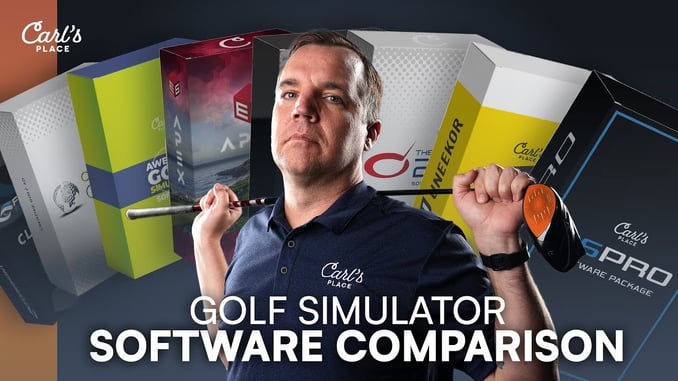
Software is a key component of a golf simulator. It turns launch monitor readings into ball flight, data views, practice tools, and virtual courses, depending on the program you use.
It takes the available club and ball data from your launch monitor and uses it to show your shot on a simulated driving range or virtual golf course.
Some basic and free golf simulation software offers just a driving range, while other higher end software offers full virtual course play, training tools, mini games, and extensive customization.
In the video below, we break down the most important differences that actually affect your day-to-day simulator experience: course realism, training features, pricing models, ease of use, course libraries, hardware requirements, and whether swing camera support is built in (or not).
Watch the video summary
Comparing Golf Simulator Software
- Course play vs. practice: Do you want immersive rounds on great-looking courses, laser-focused training tools, or a mix of both?
- Graphics and realism: Some options focus on “wow” visuals and true-to-life lighting/terrain, while others keep things more basic but still fun.
- Ball physics: The way the ball bounces, rolls out, and reacts can feel dramatically different from one program to the next.
- Training modes: Range sessions, skills challenges, club/ball data views, and tools that help you actually improve.
- Family-friendly games: Mini games and arcade-style modes can make the simulator easier to enjoy with kids or casual players.
- Swing camera support: Some software supports swing cameras directly, while others don’t (meaning you’ll rely on your launch monitor’s tools instead).
- Compatibility: Third-party software may work with multiple launch monitors, while native software is built for a specific brand.
- Pricing: Some are one-time purchases, others are annual subscriptions, and some offer multiple tiers depending on your needs.
- Course count and availability: Quantity matters, but so does course quality. Some libraries are professionally built, others are user-created with varying results.
- What you’re running it on: Some software expects a capable gaming PC; others can run on a tablet or mobile device.
Outside of the basic software that comes with each launch monitor, Carl’s Place offers the most popular golf simulator software options.
Third-Party vs. Native Software
In general, you’ll be choosing between:
- Third-party software: Can work with multiple launch monitor brands, depending on compatibility and licensing. Popular options include GSPro, E6 Connect, E6 by TruGolf, Creative Golf 3D, and Awesome Golf. TGC 2019 is a legacy option for existing users.
- Native software: Built for a specific launch monitor brand, often offering tight integration and reliable performance, but usually with less flexibility for switching hardware later.
Getting the Best Graphics From Your Software
The graphics you see depend on more than the software itself. On a PC, the graphics card renders the course, while the computer sends the image to your projector or monitor. Before choosing a program or buying a computer, check the software developer’s current requirements for the resolution you want to play at. Running a program smoothly at 4K generally calls for more graphics power than 1080p. If you plan to use a tablet, check that version’s features and device requirements separately.
Match the image to your projector
A 4K projector can display a 1080p signal, but that doesn’t give you a true 4K image. To get the benefit of 4K, the software needs to render at 4K, and your computer and video connection need to deliver a supported 4K signal to the projector. Resolution affects image detail; refresh rate affects how smoothly motion appears. Check what your projector supports at the resolution you want to use.
If the picture looks rough or play gets choppy
- Check the computer’s output. In Windows Display settings, select the projector and confirm its resolution. Under Advanced display, check the refresh rate. A higher supported refresh rate can make motion smoother, but it won’t make a low-resolution image sharper.
- Check the software’s graphics options. If gameplay stutters, try a lower graphics quality setting or in-game resolution, where available. Change one setting at a time so you can see what helps. The highest setting isn’t always the one that plays best on your PC.
- Adjust the picture. Some software offers brightness, contrast or color controls that can help the image look better in your room. TruGolf’s newer E6 software, for example, includes frame rate, brightness, contrast and gamma settings under System Settings.
- Use settings for one program when you need them. If you have an NVIDIA graphics card, NVIDIA Control Panel’s Manage 3D settings > Program Settings lets you adjust a particular simulator program without changing the global settings for everything else on your PC.
For more on choosing the hardware, see our golf simulator computer build guide and projector buying guide.
Quick Highlights From Our Testing
If you want a shortcut before you dive into the full comparison sheet, here are the most “real-world” takeaways from the video.
GSPro
GSPro is one of the most popular third-party options right now because it balances realism, customization, and value. It’s an annual subscription (currently $250/year) and offers a huge course library with strong graphics, assuming your computer can keep up.
- What it’s best at: Overall value, realistic ball behavior, and lots of variety through user-created courses and game modes.
- What to know: Course quality can vary since many are user-designed, but the top-rated courses are often excellent.
- PC requirements: GSPro lists different hardware recommendations for 1080p and 4K. Check its current system requirements before buying a computer or planning a 4K setup.
- Customization: Extensive settings for weather, time of day, season, green speeds (stimp), pin locations, tee boxes, and more.
- Swing camera note: GSPro’s shot replay is not the same as video of your swing. If you want swing footage, check your launch monitor’s camera tools or a separate compatible camera setup.
TGC 2019 (Legacy Software)
TGC 2019 was a long-time favorite for golfers who wanted a massive course library and a one-time purchase instead of a yearly subscription. It is no longer in our current software lineup, but existing simulator users can still play it.
- Online play: ProTee says network play and its hosted course library remain available for TGC 2019 for Simulators.
- Offline play: Some courses work offline; others require an active internet connection.
- Why it was popular: Huge course variety, no recurring fees, and a familiar simulator experience.
If you’re shopping for a new setup, GSPro and E6 by TruGolf are two current options to compare.
E6 Connect and E6 by TruGolf
E6 Connect has been a staple for years, while E6 by TruGolf is the newer platform. In our testing, E6 Connect’s curated courses stand out for their quality. E6 by TruGolf combines premium courses with a much larger library of AI-generated on-demand courses, and the newer platform shows a noticeable jump in visual quality, especially for higher resolution setups.
- What it’s best at: Course play, practice tools, and a range of pricing options. Check which E6 version and subscription you’re comparing.
- What to know: Customization is available, but generally not as deep as GSPro.
- Device options: E6 Connect has supported iPad play. E6 by TruGolf (2026) currently runs on Windows PCs; check the version and device requirements before buying.
Creative Golf 3D and Awesome Golf
These options tend to shine for casual players and families. They offer fun game modes and a lighter, more arcade-style experience, while still including course play.
- What it’s best at: Family-friendly mini games, variety beyond “serious golf,” and an easy on-ramp for new golfers.
- What to know: Graphics and course depth usually won’t match the more simulation-first options.
Native Software Notes: A Few Standouts
Native software can be a great experience when you want tight integration with your launch monitor brand. Here are a few key points from the video that are worth knowing as you compare options.
Foresight: FSX Play and Foresight Premier
Foresight has introduced Foresight Premier, its newer PC simulator software, through the Foresight+ membership platform. FSX Play remains usable for customers who already have a perpetual license. Some existing product packages still include FSX Play, so check the software and courses included with the specific launch monitor or package you’re considering.
- What it’s best at: High-end, data-driven practice and course play.
- Swing camera support: FSX Play supports more than one swing camera in supported versions; swing video features in Foresight+ depend on the membership tier.
- Courses: Included courses depend on your package or membership, with additional course access available through eligible subscriptions.
Uneekor: View and Refine
If your goal is getting better at golf, Uneekor’s software tools are a standout. We appreciate the training-focused feature set: club and ball feedback that varies by launch monitor, customizable data views, multi-window setups, and swing replay tools that let you draw lines and analyze angles. Software access varies by membership; Uneekor also offers GAMEDAY for course play.
- What it’s best at: Training, feedback, and swing analysis.
- Favorite feature mentioned: Slow-motion replay through impact (great for understanding swing path).
- Extras: Compatible Swing Optix cameras work with VIEW and REFINE/REFINE+, while access to some tools and games depends on the Uneekor membership tier.
Trackman: TPS
Trackman’s simulator software is a premium experience with highly detailed course rendering and realistic lighting. The engaging game modes feel fun without being gimmicky.
- What it’s best at: Premium, immersive course play and a robust overall experience.
- Game modes: Mini games and competitive challenges that keep practice sessions engaging.
- Why it’s a favorite: Excellent quality across the board. Courses, graphics, and overall experience.
Garmin: Home Tee Hero
Home Tee Hero stands out for course selection and accessibility. Garmin updated its course graphics in 2026. Approach R10 users can run Home Tee Hero through a compatible smartphone, while Approach R50 can run it on the launch monitor itself; an active Garmin Golf membership is required.
FlightScope and ProTee Labs
FlightScope’s software leans training-first and is available across devices, with upgrade paths for more data and face impact tools. ProTee Labs is described as a more scaled-back training setup focused on practice, with helpful slow-motion visuals and feedback tools depending on the hardware.
The “best” golf simulator software depends on what you actually do most in your simulator. If you want the best third-party value and broad compatibility, GSPro is hard to beat. If you’re serious about improving your swing, Uneekor’s training tools are among the best available. And if you want a premium native experience with top-tier visuals and polished gameplay, Trackman sets the bar high.
Which software do you use (or plan on trying) in your simulator? Let us know in the comments.
Search articles by tag:
Golf Simulators Resources GSPro Software Creative Golf 3DRelated Posts

How-To, Golf Simulators, Resources
Building Your Golf Simulator PC? How To Meet All the Specs
Golf Simulators, Launch Monitors, GSPro, TruGolf, Software, Foresight Sports, Trackman
How to start an indoor golf league using your simulator

Golf Simulators
Highlights from the PGA Show 2025