The Carl’s Place design team creates virtual golf courses for simulators. Some are based on real courses. Some are pure imagination. Either way, the goal is the same. Make it fun to play year round.
Designing Courses for Virtual Golf
Playing a course you recognize has always been part of the appeal of virtual golf. Familiar layouts help you trust what you’re seeing and feel connected to the shots you’re hitting.
But simulators also make room for something different. They allow courses to be designed without real world constraints. Where creativity can take center stage.
The Carl’s Place design team works in both worlds. Sometimes the goal is to recreate a course golfers already know. Other times it’s to design something entirely new, built specifically for how golf is played on a simulator.
And when you see both approaches, the difference in intent becomes pretty obvious.
Case Study: Lost Island
Lost Island is a nine hole, par 3 fantasy course set on a mysterious island in the Pacific Ocean. Unlike a real world recreation, this course started with a blank canvas.
Without real land constraints, the Carl’s Place design team focused on creating a course that feels playful, memorable, and rewarding to play on a simulator. The result is a layout built around creative shot options, dramatic visuals, and multiple legitimate chances at a hole in one.
The course plays across ancient ruins, steep cliffs, and hazardous carries. Hole 7 is the signature hole and takes place entirely inside a cave, where lighting, sound, and scale were all designed to heighten the experience without distracting from the shot.
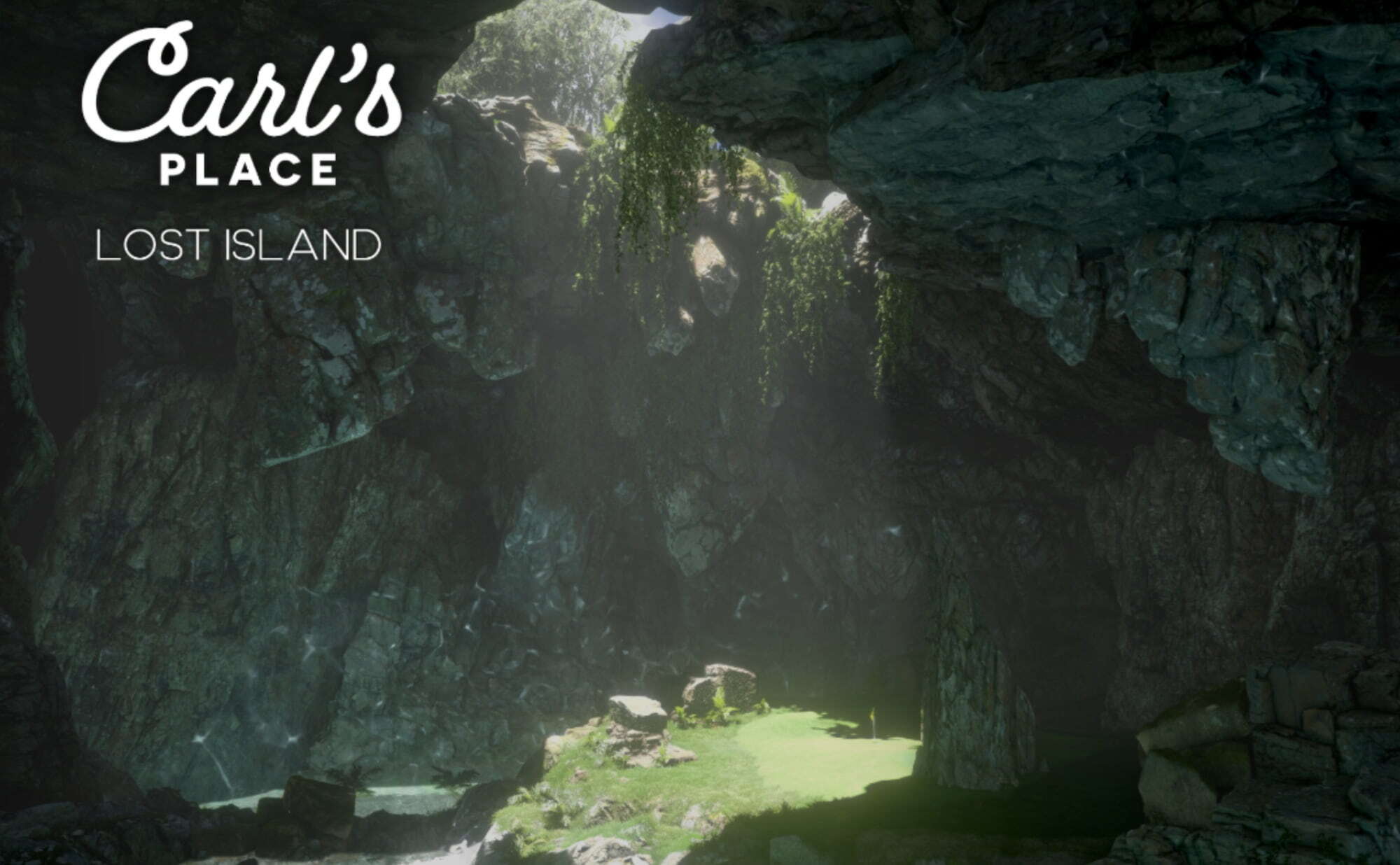 Lost Island leans into what simulator golf does best. Watching the ball chase. Feeling suspense on a carry. Taking a line that might not make sense outdoors, but feels perfect on screen.
How to play Lost Island
In GSPro, open the course library, search for Lost Island, then download the course.
Behind the Design of Lost Island
Lost Island shows what is possible when creativity leads the way. But not every course is meant to surprise you. Some are meant to feel familiar, and to play the way you remember.
Case Study: Redwood Run
Redwood Run is a new Carl’s Place-designed GSPro course that trades big drives for creative shot-making. Set in a dense redwood forest, this 9-hole par 3 course challenges golfers to shape shots through the trees, use the contours of the land and find smarter ways to get close to the pin.
Instead of a typical target-golf par 3, Redwood Run rewards imagination. Low punch-and-run shots, alternate routes and calculated misses can be just as useful as flying one straight at the flag.
The course is available in GSPro as two separate layouts, Redwood Run and Redwood Run Alt, each with different tee locations that create new angles, shot shapes and ways to attack each green.
How to play Redwood Run
In GSPro, open the course library, search for Redwood Run, then download the course.
Case Study: Rainbow Springs
Rainbow Springs Golf Course in Mukwonago, Wisconsin closed years ago, but for golfers who played it regularly, the course was still easy to picture. Certain holes stuck with you. Certain misses felt familiar.
Recreating Rainbow Springs meant working within real world constraints. The routing was already defined. The landing areas mattered. The greens needed to punish and reward shots the same way they did outdoors.
The Carl’s Place design team used available photos, drone footage, scorecards, and firsthand knowledge to bring the course into GSPro. The goal was not just to make it look right, but to make it play the way golfers remembered.

Left: Drone footage of hole 10 from years after Rainbow Springs Golf Course closed. Right: Hole 10 on GSPro golf simulator software, recreated by Carl’s Place for virtual play.
Golfers who had never played on a simulator before recognized holes immediately. Shots they expected to work did. Shots they remembered getting away from them still found trouble.
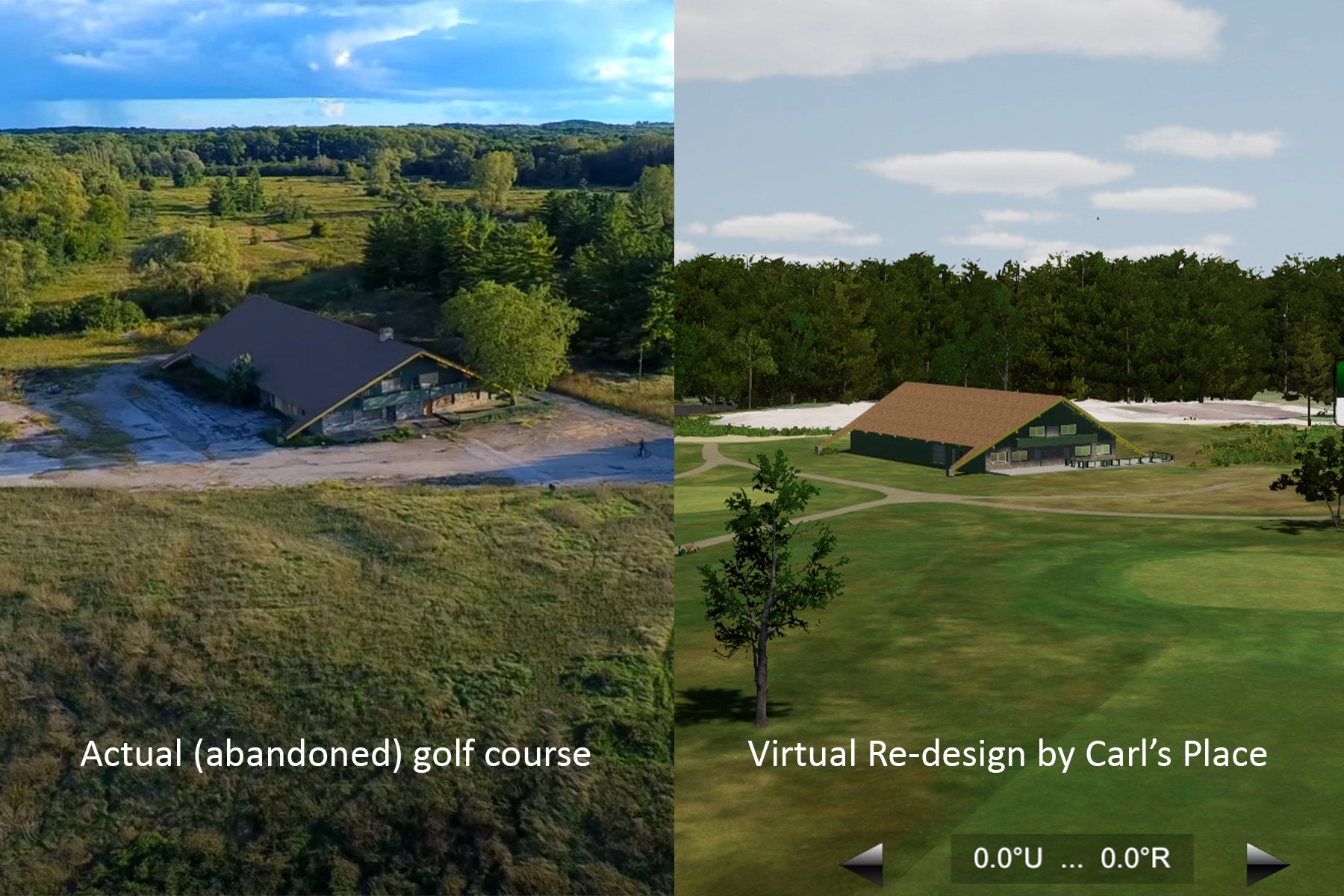
“I can’t believe how accurately this plays. The holes play true to life, and the attention to the little details really take me back,” one golfer said.
Another added, “Man, I hate this hole. I always hit it long over the green and it would trickle down a hill, and that’s exactly what just happened to me.”
Rainbow Springs shows what realistic virtual course design can do. It preserves a course people care about and keeps it playable year round, long after the fairways themselves are gone.
Remembering a Real Course vs. Discovering a Fantasy Course
Some virtual golf courses stick with you because you already know them. You recognize the landing areas. You remember where shots tend to go wrong. Playing them feels familiar in the best way.
Other courses stick with you because they surprise you. You’re reading slopes for the first time. You’re discovering the course based on curiosity.
Rainbow Springs leans into memory. Lost Island shows the other side of the spectrum. It’s not about memory. It’s about discovery.
Both approaches work when the design matches the experience the course is meant to deliver, and both can be a blast to play on a simulator year round.
Why Design Choices Matter on a Simulator
On a simulator, course design is harder to hide behind. You move faster. You play more shots in less time. You replay holes instead of walking to the next tee.
That pace makes design decisions show up immediately.
If a hole drags, you feel it. If a line is interesting, you want to try it again. If a green feeds the ball in a satisfying way, you remember it.
Replayable courses aren’t built on visuals alone. They offer different ways to play the same hole, it stays interesting. You start experimenting. You start competing. And suddenly you’ve played the same nine holes five times without realizing it.
Behind every course that earns a spot in your regular rotation is a designer making intentional choices about pacing, difficulty, and feel.
Across golf simulator softwares, designers approach that challenge differently. Some focus on accessibility, creating layouts that help new players get comfortable. Others refine courses that reward repeat play and deeper strategy. That range of approaches is what makes simulator golf work.
From a player’s perspective, great virtual courses just play well. They feel right. They fit the way simulator golf is actually played. And they keep people coming back.
Inside the Carl’s Place Design Process
Every course starts with an idea, but it rarely ends there. Early concepts get tested, adjusted, and sometimes completely rethought once they’re playable.
Feedback matters. How a hole looks on paper is very different from how it feels after a few rounds. That back-and-forth is where good courses turn into great ones.
.jpg?width=1600&height=1600&name=carls-course-design-gspro%20(2).jpg) The Carl’s Place design team doesn’t rush that process. Iteration is part of the work, and it’s one of the reasons the finished courses feel polished without feeling overworked.
The Carl’s Place design team doesn’t rush that process. Iteration is part of the work, and it’s one of the reasons the finished courses feel polished without feeling overworked.
Common Questions About Virtual Course Design
What simulator software are these courses designed for?
Carl's course designers design custom virtual courses specifically for GSPro. Every simulator platform handles visuals, ball behavior, and course logic differently, so courses need to be built with the software in mind. Designing for GSPro allows us to focus on how golf actually plays inside that environment.
Are fantasy courses just for fun, or do they hold up for serious golfers?
They can absolutely hold up for serious golfers when they’re designed well. A fantasy setting doesn’t change what good golfers care about. Shot options, fair punishment, and greens that reward the right miss still matter.
The best fantasy courses use creativity to create better decisions, not distractions. Clear lines, thoughtful risk and reward, and repeatable shot values are what make a course worth playing more than once.
When those fundamentals are in place, a fantasy course can be just as challenging and replayable as a real-world recreation, with the added benefit of variety you don’t get outdoors.
Is it possible to simplify a course for beginners?
Yes. A course can be designed to be welcoming without being boring. Wider landing areas, clearer visuals, fewer forced carries, and smarter pin placement can make a course feel more playable while still holding up for better players.
How long does it take to design a virtual golf course?
It depends on the type of course and the level of detail. Real-world recreations usually take Carl's Place designers longer because accuracy matters. Fictional courses can move faster in some ways, but still require testing and refinement to make sure they play well.
Do greens play differently indoors than outdoors?
They can. In a simulator, you’re not dealing with real turf speed or weather, but you are dealing with how the software handles slopes, breaks, and pace. Good virtual greens are designed so putting feels fair, readable, and consistent across repeat play.
Can a custom virtual course be kept private?
Yes. Some courses we keep out of the public for a specific facility, group, or purpose and are shared privately. Others we design for public play. We upload courses designed by the Carl's Place Design Team to the GSPro course library so players can download and play them.
Where Virtual Golf Is Headed
Virtual golf keeps evolving. Visuals are getting better. Audio is becoming more immersive. Designers are learning how to use space, pacing, and perspective in ways that only work on a screen.
Some future courses will look more realistic than ever. Others will lean further into creativity. The through line will stay the same. Courses that are fun to play will always win.

Search articles by tag:
Golf SimulatorsRelated Posts
Golf Impact Screens, DIY Golf Enclosures, Golf Simulators, Resources
Customer Feature: Daniel “DJ” Johnson’s DIY Golf Simulator
Golf Impact Screens, DIY Golf Enclosures, Golf Simulators, Resources
Customer Feature: Dennis Miller’s DIY Golf Simulator

Golf Simulators, Golf Enclosures
Customer Spotlight: Fairways of Woodside