We’ve all heard it: drive for show, putt for dough. You can bomb drivers in a golf simulator all day, but if you’re trying to shave strokes, the putter deserves some simulator time too.
Putting may seem like the simplest part of golf, but it’s often where rounds and weekend bragging rights are won or lost. And yes, you can work on it indoors.
With the right launch monitor, software and setup, you can practice putting from home using a golf simulator. But how does simulator putting actually work? And is it useful for real improvement?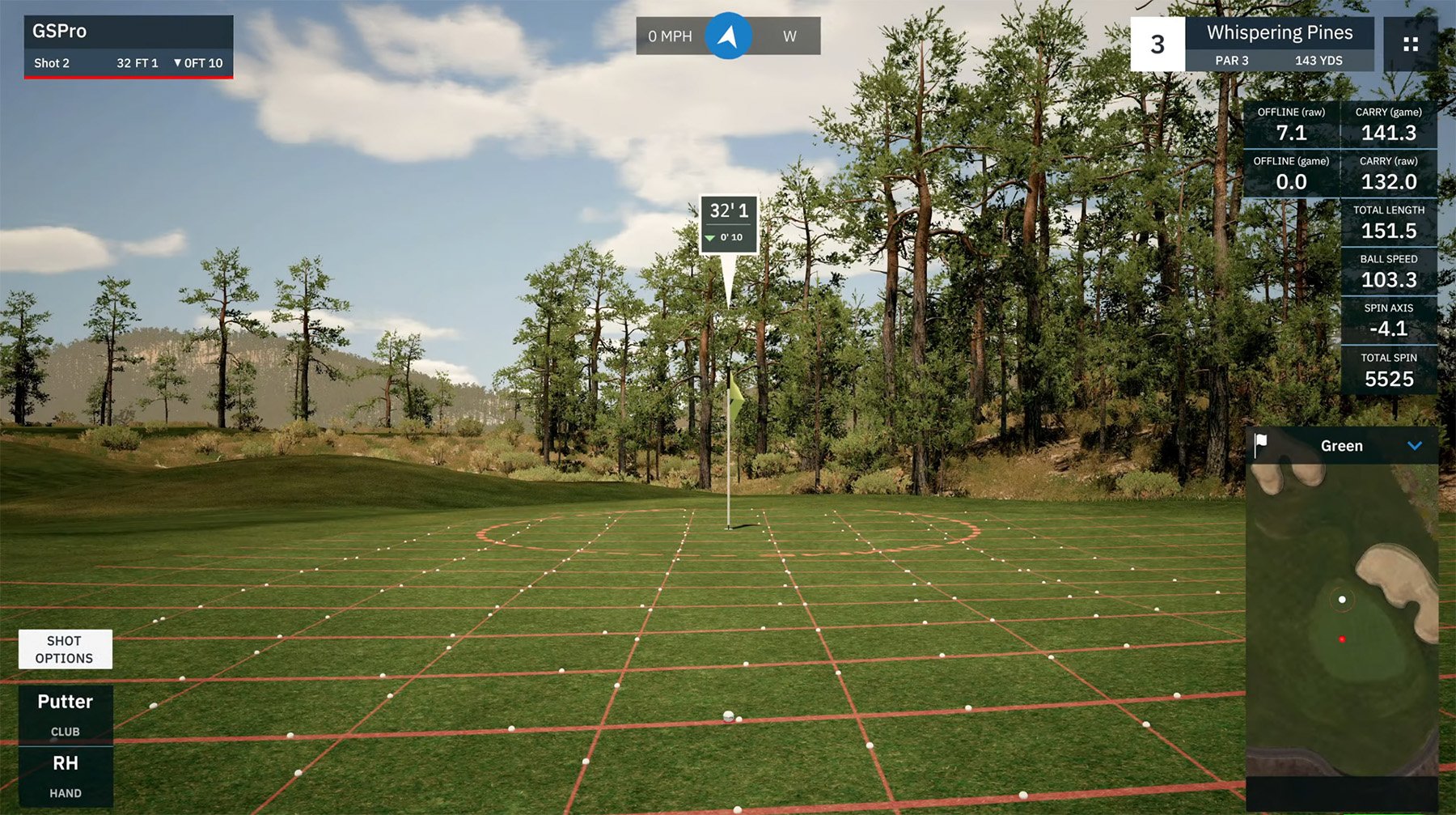
Can You Putt on a Golf Simulator?
Yes, you can putt on a golf simulator, as long as your launch monitor can read putts and your software supports putting.
Software like GSPro can show how your putt rolls on a virtual green, but the quality of the experience depends on your launch monitor, flooring setup, and software settings.
Many launch monitors can support simulator putting. Check the model if putting data like ball speed, launch direction, face angle, skid, roll, or club path are provided. Some budget-friendly launch monitors either don’t read putts or don’t read them consistently enough for realistic simulator putting. Mid- and high-end launch monitors are usually better equipped to capture slower ball speeds, shorter roll distances, and the little details that matter on the green.

What It’s Actually Like to Putt on a Golf Simulator
Putting on a golf simulator feels a little different than putting outside. You’re still making a real putting stroke, but the ball only rolls a short distance before the launch monitor and software take over. Instead of watching the ball roll all the way to a physical cup, you’re watching the result play out on the screen.
That means setup matters. Your putting surface should be as flat and smooth as possible, and your hitting area should sit flush with the surrounding turf if you can make that work. If the ball drops off a raised mat, bumps over uneven flooring, or rolls through a seam, your launch monitor may not get the clean read it needs.
Aim can feel different indoors too. Some golfers aim at the screen, some use an alignment mark or start line on the turf, and some rely more heavily on the software’s aim point. There’s a little adjustment period, especially if you’re used to reading real grass and seeing the full roll of the ball.
Most simulator software gives you a few ways to handle putting. You can usually putt everything out, use auto-putt, or set a gimme distance so short putts are counted as made. If you’re practicing, putting everything out gives you better feedback. If you’re playing a casual round, gimmes can keep everyone from spending ten minutes on one virtual green.
The best way to make simulator putting feel more realistic is to treat it like its own skill. Dial in your setup, use consistent aim points, and pay attention to speed control. It may not feel exactly like putting on real grass, but it can still help you build a more repeatable stroke.
How to Practice Putting in GSPro
Most golfers use GSPro to play rounds, but it can also be useful for putting practice. The key is using practice mode instead of only putting from wherever your approach shot happened to land.
Use On Course Practice
From the GSPro main menu, choose Practice, then On Course Practice. After you load a course, use the ball placement tool to drop your ball in different spots on or around the green. That means you can practice the same putt over and over instead of playing a full hole just to get back to one tricky spot.
This is especially helpful for working on uphill putts, downhill putts, side hill putts, and those annoying breakers that make you question your life choices.
Adjust your putting settings
Before you start, check your putting-related settings. GSPro lets you adjust options like gimme settings, auto-putt, green speed, Putting Assist, and the Breakline Indicator. Those settings decide whether putting feels closer to real golf or closer to keeping the round moving.
If you’re practicing seriously, use settings that make you putt more shots out and rely less on assistance. If you’re playing a casual round with friends, a larger gimme distance or auto putt option can keep things moving.
Use the Breakline Indicator as a learning tool
The Breakline Indicator can help show the direction and severity of the break on the green. It's useful when you’re learning how GSPro greens react, but try not to lean on it forever. Read the putt first, pick your line, then use the indicator as a check.
Track your practice data
GSPro also includes a shot data table in practice modes. You can review the shots you’ve taken and export the data as a CSV file if you want to look at more detail later.
A simple way to practice is to pick one green and hit five putts from three distances, such as six feet, 12 feet, and 30feet. Pay attention to whether your misses are short, long, left, or right. Do the same drill over multiple sessions, and you’ll get a better sense of whether your speed control is actually improving, not just whether it felt better that day.
How Does a Golf Simulator Track the Ball?
Wondering how a golf simulator tracks your ball during putting? It comes down to the type of launch monitor you’re using.
Camera-based systems from brands like Foresight Sports, Uneekor, and SkyTrak use high-speed cameras to capture images of the ball at or near impact. That can be helpful for putting because the system is reading the ball close to where the stroke happens.
Radar-based systems track the ball by sending out radio waves and reading how those waves bounce back as the ball moves. With radar, the longer the system can see the ball roll, the better. That means a flat putting surface all the way toward your impact screen can help.
If your hitting mat sits higher than the surrounding turf and the ball drops off the edge, a radar unit may lose sight of the ball before it gathers enough data. That can lead to missed reads or less accurate putting results. It’s also just nicer to watch the ball roll naturally instead of watching it fall off a mat like it gave up halfway there.
When they’re set up correctly, these systems can give useful putting feedback. Whether you’re using a dedicated putting area or simply rolling putts from your hitting strip, your launch monitor and software need clean data to give you a realistic result.
Best Launch Monitors for Golf Simulator Putting
When you’re looking for a simulator setup that can handle putting, pay attention to the launch monitor first. Software matters, but the launch monitor is what has to capture those slow, short putts accurately.
Below are not the only options for golf simulator putting, but they are some of the better known choices for golfers who want to practice short game indoors.
Foresight Sports Launch Monitors
Foresight Sports launch monitors, including the GCQuad, are popular for simulator putting because they use camera-based technology to capture ball data near impact. That can be helpful for short putts where the ball does not travel far before the system needs to read it.
For golfers who want more putting-focused feedback, Foresight Sports offers putting analysis options for GCQuad. As with any launch monitor, the experience still depends on the model, setup, and software you’re using.
Trackman iO
Trackman iO is built specifically for indoor simulator play and uses radar, infrared, and high-speed imaging to capture ball and club data. For golfers who want a premium indoor setup, it can be a strong option for full swing practice and simulator play that includes putting.
Trackman Performance Studio also includes putting-related tools and modes, which can help golfers spend more focused time on the part of the game that tends to ruin an otherwise decent scorecard.
SkyTrak Launch Monitors
SkyTrak launch monitors can be a more approachable option for golfers who want simulator practice without jumping straight into the highest-end launch monitor category. SkyTrak Max uses both radar and photometric camera technology to capture golf ball and club data.
Uneekor Launch Monitors
Uneekor launch monitors use high-speed camera technology to capture ball and club data. Some models are mounted overhead, while others sit near the hitting area. Because camera-based systems capture the ball close to impact, Uneekor can be a strong option for simulator putting when properly set up.
For golfers who want to practice more than just full swings, Uneekor systems can help with putts, chips and other shorter shots where accurate reads matter.
Putting Drills to Try in Your Golf Simulator
Once your simulator is set up for putting, it’s time to use it for more than tapping a few balls around before your round. Here are a few simple drills to help improve your indoor putting.
Straight Putt Drill
Start with straight putts from different distances and focus on start line and speed. Try three foot, six foot and ten foot putts, and pay attention to whether your misses are mostly left, right, short or long.
This is a good drill for building confidence over short putts, especially the ones that somehow feel twice as long when they’re for par.
Breaking Putt Drill
Use your simulator software to practice putts with different breaks. Work on reading the virtual green, choosing a start line and matching your speed to the amount of break.
Breaking putts are where simulator software can be especially useful because you can practice different slopes and green speeds without waiting for a spot to open on the practice green.
Lag Putting Drill
Work on distance control by setting up longer putts and trying to stop the ball inside a small target range around the hole. Don’t worry about making every putt. The goal is to leave yourself an easy second putt.
Lag putting is one of the best ways to make simulator putting useful because it trains speed control, not just aim. And speed control is usually what keeps a harmless two putt from turning into a story you don’t want to tell.
Is Simulator Putting Worth Practicing?
Yes, simulator putting can be worth practicing, especially if you use it for the right things. It is not a perfect replacement for reading real grass, dealing with grain or feeling outdoor green conditions under your feet. But it can help you work on speed, start line, routine, and confidence.
The key is having the right expectations. A simulator is not magically going to fix your putting stroke overnight. But if your launch monitor reads putts well, your surface is flat, and your software settings are dialed in, it gives you a convenient place to put in more reps.
Whether you’re using a high-end launch monitor or a more budget-friendly setup that supports putting, a golf simulator can be a useful tool for improving your short game. With the right launch monitor, software, and setup, you can turn your simulator into a place to practice the part of the game that usually decides the score.
Golf Simulator Putting FAQs
Can you putt in GSPro?
Yes. GSPro supports putting when paired with a launch monitor that can accurately read putts. GSPro shows the putt in the software, but your launch monitor still has to capture the ball data first.
Why won’t my putts register in GSPro?
The issue is usually related to the launch monitor or setup, not GSPro itself. Common causes include a launch monitor that does not support putting, poor lighting, incorrect ball placement, or a hitting surface that drops off before the monitor can capture the roll.
Do all launch monitors work with GSPro putting?
No. GSPro can show the putt, but the launch monitor has to capture the putt accurately. Check your launch monitor’s putting capabilities and GSPro compatibility before assuming the software is the problem.
Should I use gimme settings in GSPro?
It depends on how you play. A smaller gimme distance feels more realistic for practice, while a larger gimme distance can help casual rounds move faster. There is no shame in using gimmes. There is some shame in arguing over a virtual two-footer for five minutes.
What is the best launch monitor for simulator putting?
The best launch monitor for simulator putting depends on your budget, software, and space. Camera-based launch monitors are often strong options because they capture the ball close to impact, but the right choice depends on the full setup.
Do you need a flat putting surface for a golf simulator?
A flat putting surface is strongly recommended. If the ball drops off a raised mat or rolls across uneven flooring, your launch monitor may miss the putt or return less accurate data. A flush hitting area and smooth turf can make simulator putting feel more natural.
Search articles by tag:
Golf Simulators GSPro Post-PurchaseRelated Posts
.webp)
Golf Simulators, Computers
Golf Simulator Computers
Golf Simulators
Golf Simulator Lighting: What To Get And Where To Mount Them
How-To, PRO Golf Enclosures
How to Assemble a Pro Golf Simulator Enclosure Kit