You want a home golf simulator. Your budget says, "Let's think this through." You don't need a huge pile of cash sitting around to get started. Financing lets you spread the cost out.
With financing, you can build the home golf simulator setup you actually want now and pay for it at a pace that makes sense. Here's how to plan it.
How Golf Simulator Financing Works
Golf simulators feel expensive because everything hits your wallet at once. Launch monitor, turf, hitting mat, enclosure, projector, computer, software.
Financing splits that cost into monthly payments instead of one big one up front, so you don't have to buy the "starter version" of your setup and upgrade later. You can start with gear you'll actually keep long term.
The process is simple. Build your setup, choose financing at checkout, and apply. If you're approved, you'll see your terms before you commit to anything.
Before you apply, keep a few things in mind:
- Your terms depend on you. Your credit, how much you finance, and how long you finance it for all factor in.
- Longer isn't always better. A longer term means smaller monthly payments, but you'll usually pay more in total. A shorter term costs less overall.
- Look at the total, not just the monthly number. Know what the whole setup will cost you by the time it's paid off.
Subject to approval of credit application. Bread Pay™ loans are made by Comenity Capital Bank, a Bread Financial™ company. Learn more about Carl's Place financing options.
What a Golf Simulator Really Costs
Starter (Under $3,000)
For under $3,000, you'll have the core basics of a golf simulator setup, but not a fully immersive one. You'll be able to hit into a net (or maybe a budget screen you rig up with eye hooks), and you might use a tablet or TV for visuals, but you won't quite get the experience of a true simulator. And look, we absolutely love the DIYers who take this route. It's creative, resourceful, and totally valid. But it's also not the "easy button."
Building a usable golf simulator at this budget typically takes time, research, trial and error, and a bit of technical know-how. If you're handy, it's a fun challenge. If you're not, you might find yourself ready for the next tier sooner than expected.
Entry Level ($3,000 to $5,000)
Once you're able to spend over $3,000, you can pull together a basic all-in-one golf simulator setup. That includes:
- an enclosure with a proper impact screen,
- a solid hitting mat,
- a basic but reliable launch monitor,
- and a projector so the ball flight shows up on your screen instead of your phone.
This tier gives you the essentials without cutting corners. It's a clean, functional setup where everything works the way you expect, no hacks, no temporary solutions, just a solid home simulator that feels like the real thing. See what you can get with a $3k golf simulator budget.
Mid-Range ($5,000 to $10,000)
This is the range where everything starts feeling "dialed." You can move into a premium impact screen, a brighter projector, a more accurate launch monitor, and generally a more immersive experience across the board. See what you can get with a $5k golf simulator budget.
Premium ($10,000 to $20,000+)
If you're dreaming big, this is where it all comes together: pro-grade launch monitors, 4K laser projectors, a fully finished enclosure, lighting, sound, and a dedicated room that feels like its own indoor golf studio. See what you can get with a $10k golf simulator budget.
Can You Finance a Launch Monitor Like a Trackman?
Yes, you can apply for financing on a launch monitor by itself. The launch monitor is often one of the biggest single costs in a build, so it's a common piece to finance.
Financing is available on launch monitors from Trackman, Foresight Sports, Uneekor, and Garmin. Same process either way: add it to your cart on its own or as part of a full build, choose financing at checkout, and apply.
Price Out Your Whole Build First
Before you apply for anything, figure out what you're actually building. Our Build Your Own tool lets you design a setup down to the inch with pricing built in, so you know the total before you apply.
From there, decide how much you want to finance and how much you'd rather pay up front. Putting some cash down on the big pieces and financing the rest is a totally reasonable way to do it.
How to Prioritize Your Golf Simulator Build When You're Paying Monthly
When you plan to pay monthly, the smartest move is to put your budget toward the pieces that make the biggest impact on how your simulator looks, feels, and performs. Some components dramatically change the experience. Others are easier to upgrade later.
Start with the essentials:
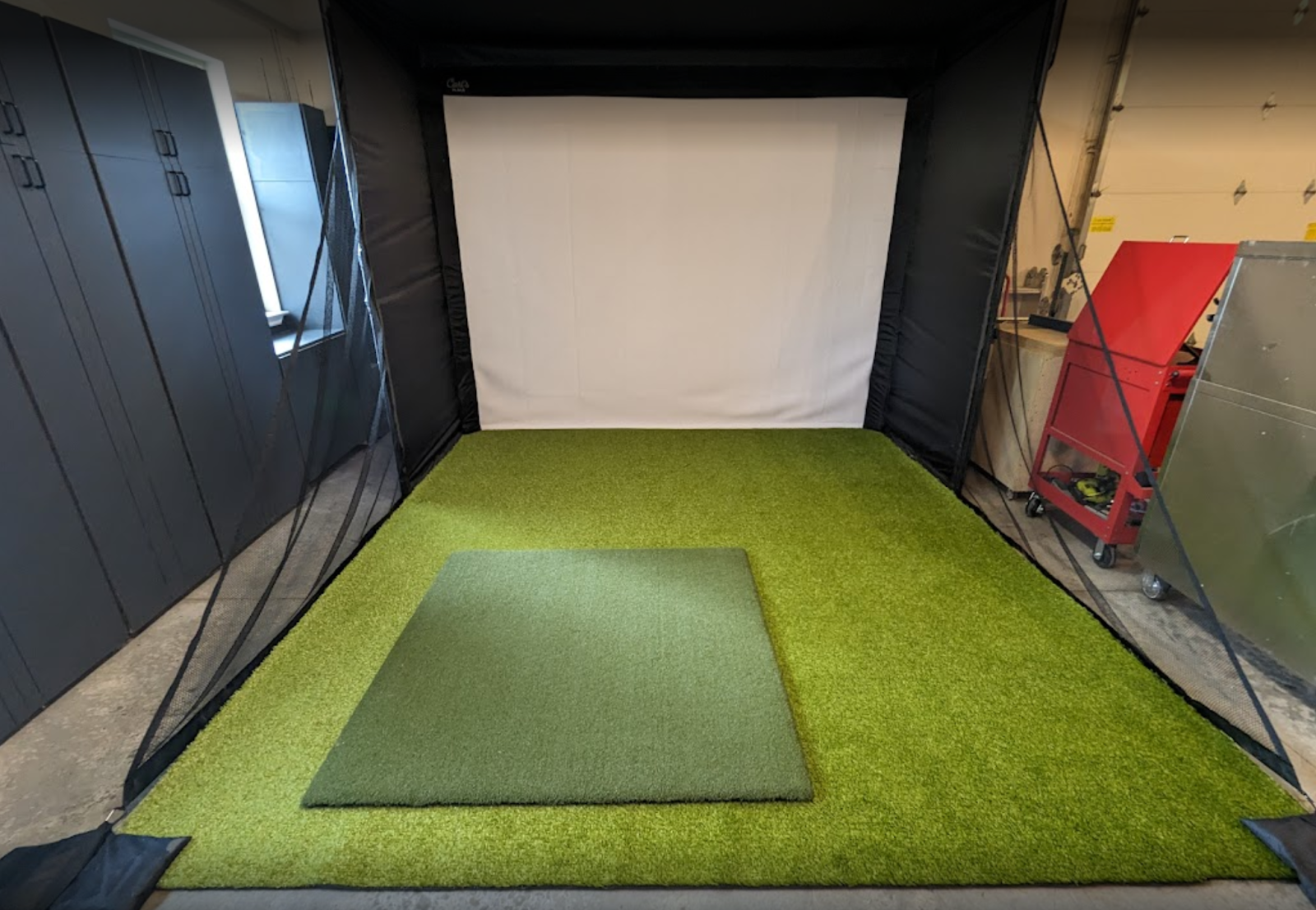
- Hitting Mat: You're not going to want to replace that outdoor fairway hitting surface with your shag carpet or cement garage floor, so you'll definitely need a hitting mat.
- Net or Impact Screen/Enclosure: Safety first! If you swing your golf club and hit a ball from your hitting mat, you won't want that golf ball hitting your drywall, a window or violently bouncing around in your garage/basement, so you'll need something to catch it. The most budget friendly option would be a net, which is where a lot of people start. However, if you're thinking about the future at all and how you're going to want to add on to your golf simulator to make it as realistic as possible, you might think about swapping out that net for one of Carl's enclosures and impact screens to catch your balls.
- Launch Monitor: The brains behind the operation, a launch monitor provides invaluable data for honing your swing and tracking your progress. Sure, you could get swings in without it, but how do you know if you're actually improving or getting worse?
Buying a launch monitor is a huge decision for many reasons, two of them being: budget and what you want to get out of it. You can find budget friendly, entry level launch monitors under $1,000, or you can invest $20,000 or more into your launch monitor; it all depends on what you're looking to get out of it.
That said, many people will start at the entry level and upgrade over time as more funds become available. Most launch monitors will require you to have a mobile device or PC to see the actual data provided on their basic driving range software, but some, such as the Garmin Approach R50 or the Foresight GC3 and GCQuad, have built-in screens that show the data right there.
With these essentials in place, you're ready to take your first swings without wreaking havoc on your budget … or your surroundings.

What to Add Next
Once the basics are in, these are the upgrades that make the biggest difference:
- Projector: You won't have that realistic golf simulator experience without projecting an image onto your screen. It's not a necessity, but man is it nice to project the golf course on the screen so that when you hit your shot, the ball takes off on the screen in front of you as it would in real life! They do vary in price, and you typically get what you pay for; however, entry level projectors can certainly do the job.
- Third-party software: Most launch monitors come with their own driving range software. Some also come with some course play options, but if you want to play some of the most popular, graphically intense courses, you'll want to invest in a third-party software.
- High-powered computer: You can run some third-party software off of a mobile device or tablet, but the most popular ones work best with a high-powered PC. Each software will have recommendations on what the specs for that PC should be.
- Safety baffles and net wall extensions: These help contain any errant shots within your golf space.
- Turf or soft flooring: Turf or soft flooring under your hitting area adds comfort and realism and cuts down on bouncing balls.
With these, you'll feel like you just flushed a 7 iron onto the green.
Nice to Have: Golf Simulator Extras
None of these are necessary to get your simulator up and running. They just make the room yours.
- Carl's Swing Cameras for visual feedback
- Club holders to keep the space clean
- Accent lighting and neon for the "wow" factor
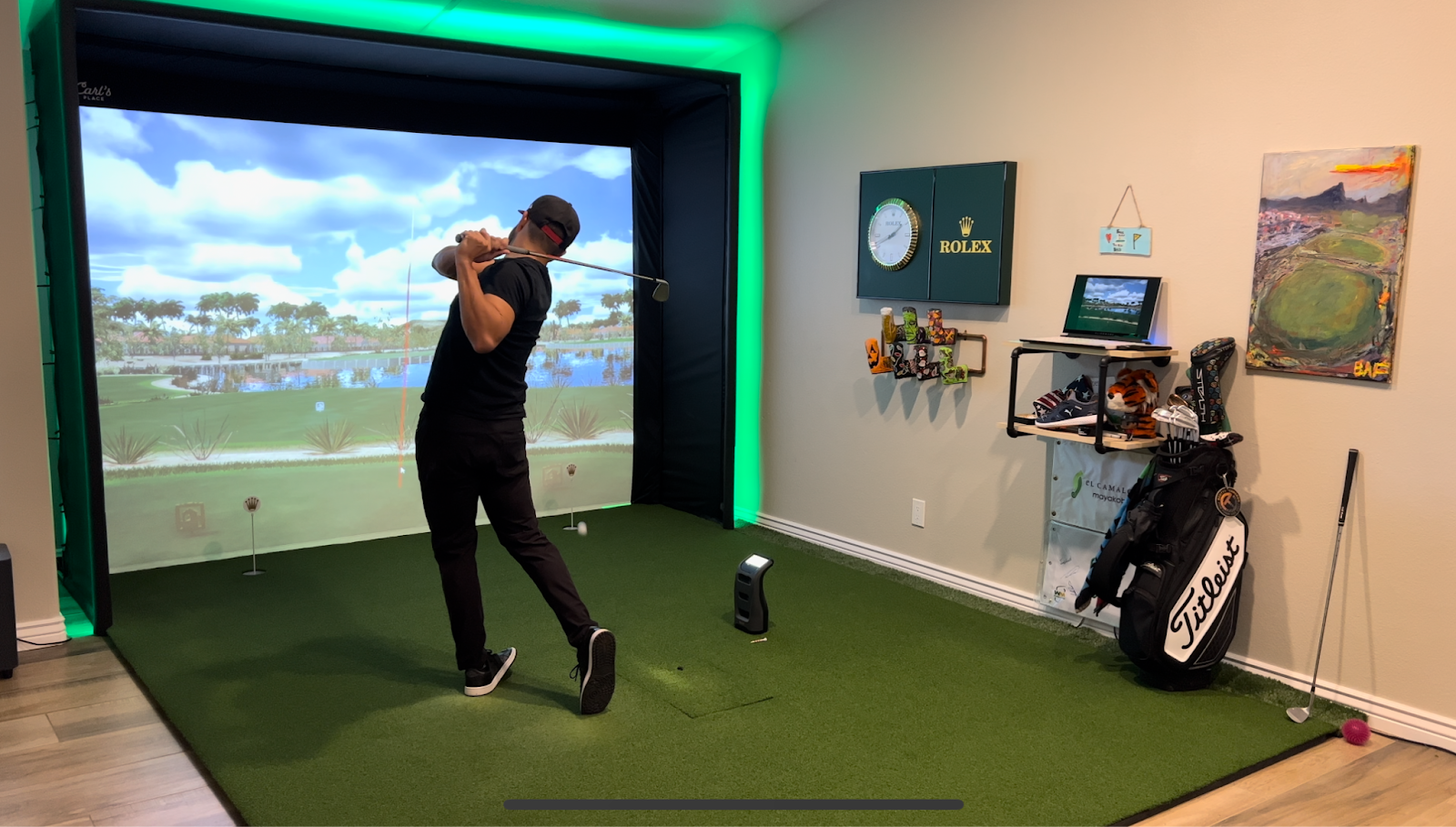
- Shelving, décor, sound, furniture to build the vibe

Why Financing Helps You Avoid the "Starter Setup" Trap
A lot of golfers start with whatever their budget allows right now: a net, a cheap mat from a retail giant, maybe a budget launch monitor, and a screen that sort of works if you pull it tight enough. It's a common path (and there's nothing wrong with it) but here's the catch:
Most people outgrow that setup fast.
They upgrade the mat.
Then the screen.
Then the enclosure.
Then the launch monitor.
Then the projector.
Then the computer.
And suddenly that "cheap" simulator has cost more in upgrades than it would've cost to build the version they actually wanted in the first place.
Financing gives you another path. Spreading the cost out lets you skip the temporary gear and build a setup you won't outgrow. Instead of buying the "for now" version, you build the right version for you, the one you'll still be using years from today.

Can You Lease a Golf Simulator?
Leasing mostly shows up on the commercial side, for golf bars, indoor golf businesses, and other venues. For a home setup, financing is the more common route, and once it's paid off, everything is yours. If you're outfitting a business, check out our commercial golf simulators.
Final Thoughts: Build the Simulator You'll Actually Love
A home golf simulator doesn't have to be a giant, save-for-years purchase. Financing lets you build the setup you actually want and enjoy it now instead of someday.
Whether you're starting simple or aiming for a full-room buildout, financing gives you room to make long-term choices and skip buying everything twice.
So go ahead and dream a little bigger.
Related Posts

Golf Simulators, Resources, Launch Monitors
Understanding Launch Angles: Overhead vs. Floor-Based Launch Monitors
Launch Monitors, Rapsodo
Rapsodo Launch Monitors - Real-World Testing & Review
Golf Simulators, Resources
How Much Does A Golf Simulator Cost?