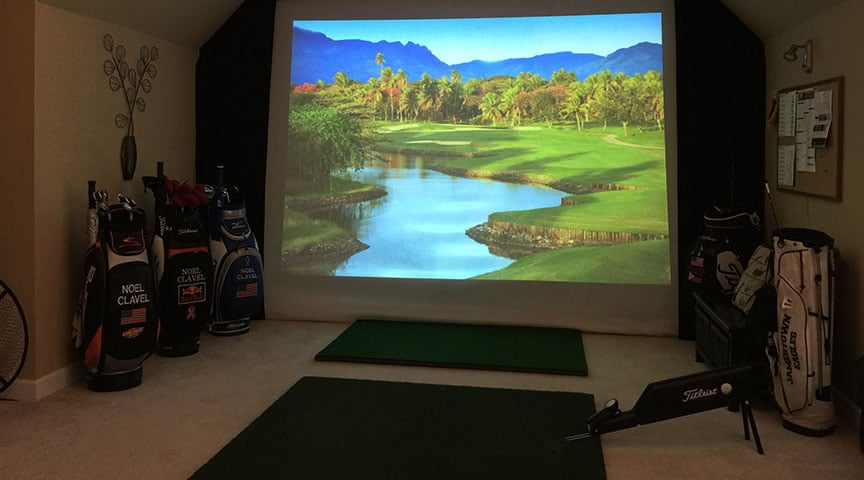
A golf simulator is a complete indoor golf system: an enclosure and impact screen, a launch monitor to track ball and club data, software to simulate shots and courses, plus a projector and hitting mat to bring it all together.
Quick Answer: What Is a Golf Simulator?
In simple terms, a golf simulator lets you play golf indoors with real clubs and real golf balls while the system shows your shots on a virtual course.
Most home golf simulators include:
- Enclosure & impact screen: the hitting bay and screen you aim at.
- Launch monitor: the device that measures your ball and club data.
- Golf simulator software: turns that data into numbers and virtual shots.
- Computer or tablet: runs the software.
- Projector: shows an image on the screen.
- Hitting mat: what you stand on and hit from.
Golf Simulator vs. Launch Monitor: What's the Difference?
These two terms get mixed up a lot, but they're not the same thing.
Launch monitor: A device that measures ball and club data. Things like ball speed, spin, launch angle, and carry distance. On its own, it does not include a screen, enclosure, projector, or hitting area.
Golf simulator: The entire indoor golf setup that uses a launch monitor plus an enclosure, impact screen or net, projector or display, software, and a hitting mat so you can actually play virtual rounds of golf.
Put another way: a launch monitor tracks the shot; a golf simulator is the complete system that turns that data into a playable indoor golf experience.
How Does a Golf Simulator Work?
Whether you've golfed a billion times or don't even know what the sport of golf is, the idea of playing golf indoors can still feel a little abstract at first. A golf simulator turns a regular room into a hitting bay: you stand on a mat, hit a real ball into a screen, and the system shows your shot flying on a virtual range or course.
Here's the sequence. You hit a real ball off the mat into the impact screen. The launch monitor reads the ball data (and club data, depending on the model) as it's struck. The software turns those numbers into a shot on a virtual course or range, and the projector puts that shot on the screen in front of you almost instantly.
Once the golf sim is fully functioning, it's often easier to use than having to drive to the golf course, check in, find your golf cart and get to the first tee on time.
Parts of a Golf Simulator
So, what is included in a golf simulator? A launch monitor is just one piece. A full golf simulator is made up of several parts that work together:
- Enclosure: the structure surrounding the hitting area to contain all your shots and keep ambient light out.
- Impact Screen: the material that you hit your ball into that also displays the projected image from your computer/tablet via a projector.
- Launch Monitor: the device that reads ball and club data.
- Software: the program on a computer/tablet that displays launch monitor data, virtual golf courses, etc.
- Computer/Tablet: what you need to run the software program to see your ball/club data and play virtual courses.
- Projector: the device that connects to your computer/tablet and then puts the image from your device onto your impact screen.
- Hitting Mat: what the golfer hits the golf ball off of.
Golf Simulator Enclosure
A golf simulator enclosure is a layer of protection around your hitting area and impact screen. It keeps out unnecessary additions, such as ambient light to help provide a bright image on your impact screen, and helps contain important equipment, such as golf balls.
Carl's Place Golf Enclosures and Built-Ins
We compare and contrast the enclosure and built-in options more in this article.
Golf Impact Screens
Impact screens do two big jobs: they safely stop your golf ball shortly after impact, and they display the projected image from your golf simulator software so it feels like you're actually on the course.
Some golfers just hit into a net, which works for basic practice. But if you want a true golf simulator experience, an enclosure with a high-quality impact screen makes all the difference. After hitting your shot, would you rather look straight ahead at a full-size virtual fairway, or glance off to the side at a small monitor every single time?
Carl's Place impact screens are purpose-built for golf simulators. They're crafted from durable, tested materials designed to handle thousands of shots from real golf balls, catching the ball and dropping it safely to the floor instead of sending it rocketing back at you. The weave and construction are engineered to balance two things that usually fight each other: long-term durability and a clean, bright image for your projector.
Because an impact screen takes a constant beating from golf balls, its surface will never be as perfectly smooth as a traditional home theater projector screen. Compared to basic hitting nets or DIY fabrics, a true impact screen from Carl's Place is built to last longer, look better, and keep your space safer while you're swinging away indoors.

Golf Simulator Launch Monitors

A golf launch monitor is the brains of the operation. It's an electronic device that sits near or around the hitting area to read all the important data as the ball is struck. That data is then transmitted to a software program on a tablet or computer to show your shot distance and shape.
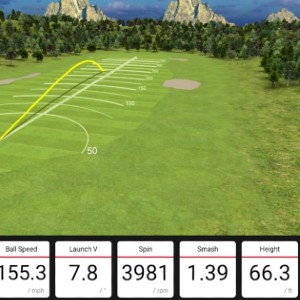
To show you what your shot looks like, a launch monitor uses a bunch of different data points, such as ball spin, ball speed, club speed, club attack angle, and much more. Launch monitors are manufactured using different technology to capture said data, including cameras, radars and sensors.
Radar-based launch monitors watch the ball fly through space and predict where it would have gone. That's why you typically need more space for a radar-based launch monitor since they need to see the ball fly.
Camera-based launch monitors watch the ball and club right at impact. Both can work great in the right room.
Alex at My Golf Simulator explains more about radar versus camera technology, saying radar-based launch monitors excel outside and in larger spaces where it can see more of the ball flight, while camera-based launch monitors typically work better in small spaces. Radars track moving subjects, such as your golf ball, and camera-based launch monitors take many pictures or video just before and after the ball is struck to gather data.
Sometimes reflective stickers or intentional marks on a ball will help either launch monitor pick up the spin on the ball, which affects most of the data output. However, some of the higher-end launch monitors require less help.
Some of the data provided by mid-end launch monitors include more basic information such as carry distance, total distance and ball speed. Higher-end models offer a lot of the same ball data, but also add in club data such as attack angle, dynamic loft, club lie angle, impact point (horizontal and vertical) and more.

Why is a launch monitor a necessity when it comes to a golf simulator setup?
Without the data it provides, there's no way for your simulator software to know how your ball would fly. You wouldn't see shot shape, distance, or be able to play any virtual courses or games.
Simply put: a golf simulator cannot work without a launch monitor, because the launch monitor is the data engine that feeds the rest of the system.
Golf Simulator Software
Golf simulator software gives your golf simulator life. It takes in the data from the launch monitor and pumps it out into easy-to-understand numbers and visuals. Some launch monitors pump out more data than others, but those launch monitors will hit your wallet a little bit harder.
A golf simulator setup won't work without software.
Using those numbers, the software shows you how your shot would look on a virtual driving range or golf course, depending on what you're playing. Along with virtual driving ranges and golf courses, some golf simulator software programs offer training and games.
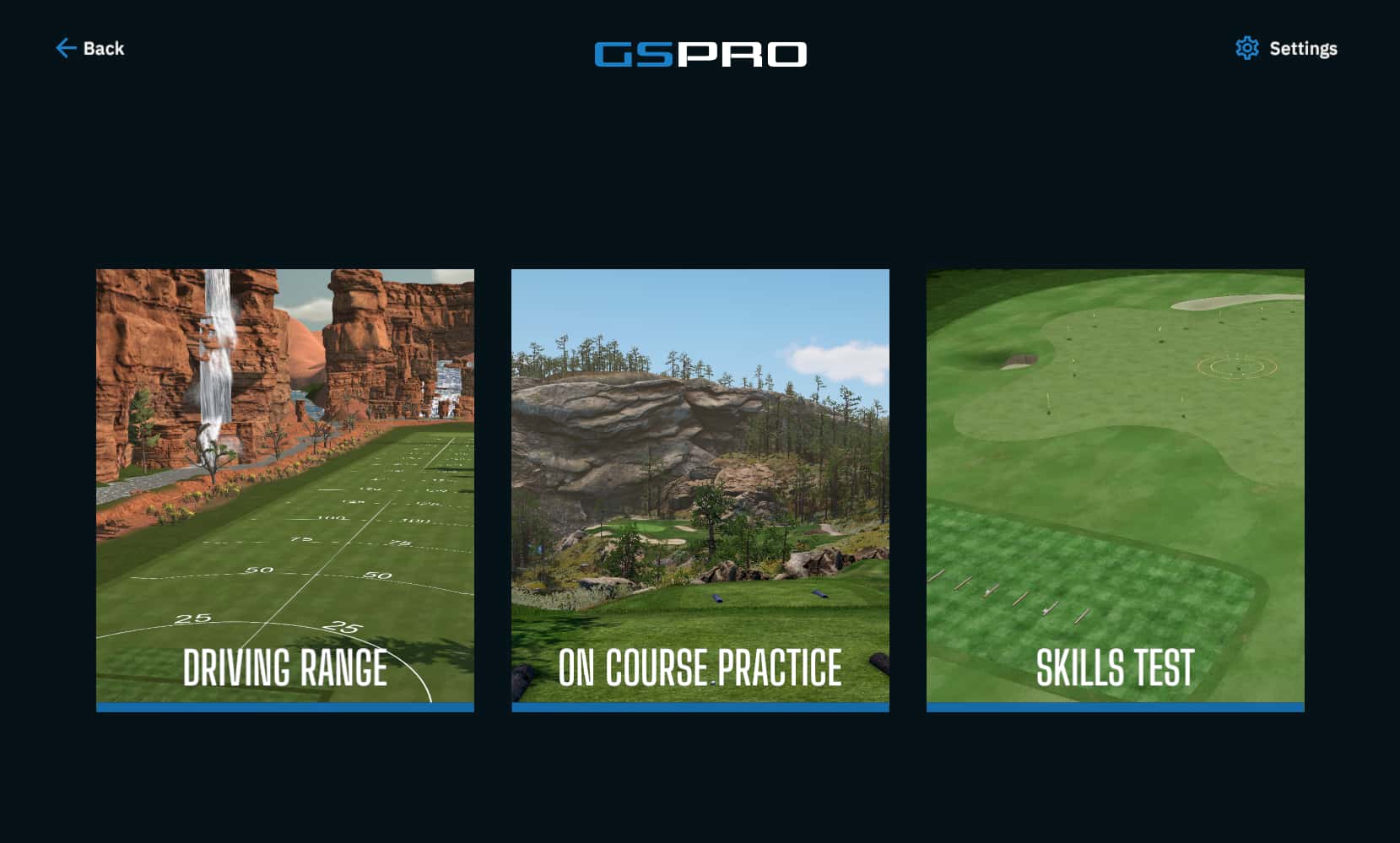
Examples of training might include approach or chipping contests to hone your short game. Sometimes the games, such as closest-to-the-pin contests, can act as training, or a game of golf darts could entertain your family and friends.

What golf simulator software programs exist?
Each launch monitor comes with its own basic software with most of them having the potential to upgrade. However, there are also third-party software options, such as GSPro, E6 Connect and Creative Golf 3D.
Each software has different graphics that appeal to different people, and some offer different golf courses. For example, E6 Connect offers famous courses in its expanded package such as Bandon Dunes and Torrey Pines.
It is important to do research on what software will fit your needs and be most aesthetically pleasing to you before you buy.

Golf Simulator Computer/Tablet/Phone
A computer, tablet or phone with the proper specs is a necessary piece of equipment for a golf simulator, otherwise you will not be able to see the data that your launch monitor puts out on your golf simulator software.
If you're just starting out, don't stress every spec right away. At a basic level, your launch monitor and software just need a device that meets or beats their minimum requirements so everything runs smoothly.
Each launch monitor and software will have recommended specs for the device that is running them. They might be able to run at those specs, but we'd say that should be the minimum you look for then. If your device's specs perfectly match the required specs from the launch monitor or software, it might not run as efficiently and possibly will lag, causing graphics to skip and just not look as good overall.
Additionally, if you purchase a computer at those recommended (or minimum) specs, any future updates to the launch monitors or software might cause you to have to upgrade your computer. If you get something more powerful right off the bat, you won't have to worry about the future as much, and will have a better experience with your current setup. Future proofing is a good idea, but also balance the future with not overspending on too much computer.
Some launch monitors don't need an actual computer since their software comes as a phone or tablet app. But if you want to play third-party software you would likely still need a separate computer. See golf simulator setups that can run on a tablet or iPad.
A common, average theme amongst the launch monitors and software we offer at Carl's Place is that, if using a computer, it is recommended to have an Intel i5 processor or better, at least 16 GB of RAM, a graphics card such as an NVIDIA RTX 3060 or better, and Windows 11. The processor and graphics card are the most important specs.
As with all pieces of your golf simulator setup, we highly suggest doing your research before pulling the trigger.
Golf Simulator Projectors

The main function of a projector in a golf simulator setup is to place the image of the golf course, driving range, game, etc. onto your impact screen to make it a more immersive experience.
We've published a ton of great information about projectors in the following articles:
4K or high definition is your call. Because of the texture of an impact screen and markings from flying golf balls, the difference between the two is less obvious than it would be on a home theater screen. If budget matters most, an HD projector will do the job. If you want the sharpest image you can get, go 4K.
The projector is a large piece of being able to set up a high-definition golf simulator. Check out when our very own Carl spoke more with Projector Central about golf simulator projectors.

Golf Simulator Hitting Mats

A hitting mat is a necessary piece of your golf simulator setup. It would not be smart to hit off of your cement garage floor, laminate basement floor or shag carpeting for obvious reasons.
That said, it is much nicer hitting off of a high quality hitting mat in a golf simulator.
There are several factors to look into when purchasing a hitting mat, such as making sure it's similar to hitting off real grass at a golf course and making sure it is soft to avoid injuries to your arms and back after swinging.
Although many hitting mats tend to be very similar, some are made quite different. According to its website, a Fiberbuilt mat is "made from a special blend of monofilaments engineered for strength and durability." These monofilaments, or synthetic fibers, act as the grass blades. Learn more about which Fiberbuilt mat is best for you.
With a mat like the TrueStrike series, the fibers are much shorter but the hitting section comes with a gel bag underneath to provide a more realistic fairway shot that will punish you for hitting too much "grass" before the ball.
Then there is the Carl's Place Hitting Mat, which provides the best of a lot of worlds: it's nice and soft, meaning you won't hurt after hitting from it, and it's budget friendly. Just be sure to keep it from sliding around in your setup!
The Fiberbuilt and TrueStrike mats are both modular, meaning they can be moved and assembled pretty quickly. The modular designs make sections of the mats easier to replace if they get worn out.

Where Can I Set Up A Golf Simulator?
Where might you find a golf simulator once it is purchased and installed? We've had customers install them in dozens of different spots, but here are some of the most common places to find them:
- Residential
- Basement
- Garage/extra storage space
- Extra bedroom
- Large living area
- Sun room
- Commercial
- Golf course clubhouse (naturally)
- Indoor golf business
- Bar/restaurant
- Offices who want to entertain employees or clients
And who in the heck uses a golf simulator in all of these places? Well, maybe it's a golfer trying to improve his game at home while also trying to save money. Or, maybe someone really wants to jump into golf and take up a new hobby or workout routine. Or, it's a member of a golf course taking advantage of those perks on inclement weather days or in the offseason at their course. Or, it's a group of friends out on the town for a night looking for something fun to do.
You get the point. Anybody and everybody can use them in many different ways.
When Is The Best Time To Use A Golf Simulator?
The obvious best times to take advantage of a golf sim are when you can't comfortably golf outside: rain, snow, extreme heat, earthquake. OK, maybe not an earthquake as that also affects indoor spaces, but the point stands.
Golf simulators are ideal setups for golfers who want to take advantage of the sport year-round in any weather.
Another hidden benefit is that golf simulators can be used at any time of the day. Can't fall asleep at night and wanna go play a quick round? Sure, get up at 2 a.m. and play a quick 18. Not a problem!
How Much Does A Golf Simulator Cost?
The cost of a golf simulator depends on a lot of factors, but depending on your budget and needs, a decent golf simulator can cost you between $3,000-$20,000, or higher if you want all the bells and whistles.
Good thing is you get to make the call on how much you want to spend. If you need some ideas, we challenged our team to build golf simulator setups with budgets of $3,000, $5,000, $10,000 and $20,000. Check out each to see which golf simulator might work best for your needs.
Our Build Your Own Golf Simulator tool will let you customize your own golf room. Check it out.

Golf Simulator FAQs
Is a launch monitor the same as a golf simulator?
No. A launch monitor is just the device that measures your ball and club data. A golf simulator is the complete indoor golf system that uses that launch monitor along with an enclosure, impact screen, projector or display, software, and a hitting mat.
Can I use a launch monitor without a full golf simulator?
Yes. Many golfers start with just a launch monitor and a net, then add an enclosure, impact screen, projector, and software later. That basic setup is great for practice, but you won't get the same fully immersive "on the course" feel as a complete simulator room.
What do I actually need for a basic home golf simulator?
At minimum, you'll need a launch monitor, golf simulator software, a safe hitting area with a mat, and something to hit into (a net or impact screen). From there, adding a dedicated enclosure, projector, and properly sized impact screen makes it feel like a true indoor golf room.
How much does a golf simulator cost?
Most home golf simulators land somewhere between about $3,000 and $20,000+, depending on how premium you go with the launch monitor, enclosure, computer, and projector. The good news: you can build it in stages and upgrade over time.
Wrap-Up
You now have all the knowledge on what is a golf simulator, how a golf simulator works, and all the parts that make it work.
Remember: the launch monitor is the brain of the system, but the golf simulator is the whole body: the complete indoor setup that lets you actually play golf inside.
To make it easy for you to get set up with the right components, Carl's Place has golf simulator packages that will help you get started with your own golf simulator setup. Check them out below.
Search articles by tag:
Golf SimulatorsRelated Posts
Golf Impact Screens, Golf Simulators, Projectors, Golf Enclosures, Launch Monitors, Hitting Mats, Software
The Ultimate Golf Room Checklist

How-To, Golf Simulators, Projectors, Hitting Mats
See Golf Sim Data on the Floor with Projection Mapping
.jpg)
Golf Impact Screens, DIY Golf Enclosures, Golf Simulators, PRO Golf Enclosures, Launch Monitors
Measuring Your Space For An Indoor Golf Simulator